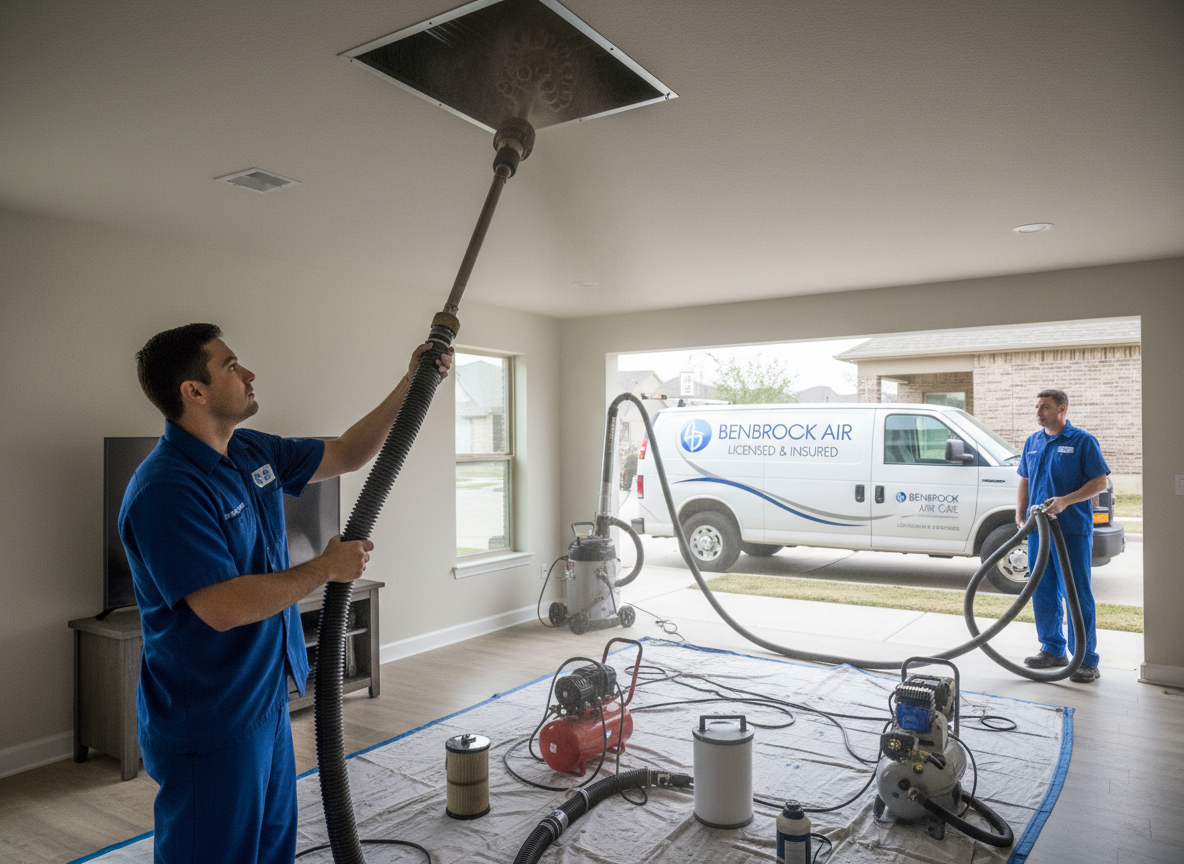
Benbrook homes, especially those built in the 1970s through 1990s near the lake and along Highway 377, often feature flex duct runs that trap fine West Texas dust and live oak pollen pushed through the system during long cooling seasons. When these lines are not cleaned properly, restricted airflow forces the HVAC blower to work harder, raising energy use and circulating irritants back into living spaces. Crews start by mapping every accessible trunk and branch with a camera so they know exactly which sections need agitation versus simple vacuuming.
Summer humidity combined with occasional heavy rains can leave residual moisture inside metal ducts routed through crawlspaces common in Benbrook neighborhoods. This creates conditions where mold spots form at joints if the system is not fully dried after cleaning. Technicians use negative-air machines sized for the home's square footage and finish with a post-job camera sweep to confirm no debris remains before restoring normal operation.
Older ranch-style houses around Benbrook's central district frequently have return-air paths routed through wall cavities rather than dedicated ducts. These hidden cavities collect construction debris from nearby Fort Worth growth and must be accessed through small inspection ports rather than full demolition. Careful sealing of every opening after service prevents the same material from re-entering the airstream during the next high-wind event.
Homeowners sometimes attempt DIY cleaning with consumer shop vacs, which only reach the first few feet of each run and leave the main trunk untouched. In Benbrook's mix of single-story and split-level homes this partial approach simply moves dust farther into the system, where it eventually restricts the evaporator coil. Professional equipment reaches the full length and removes material that would otherwise be recirculated for months.
Technician insight
In Benbrook the thing that catches most people out with duct cleaning is the number of 1980s homes where the main return runs through the wall cavity behind the laundry room; once you open that you find years of lint and sheetrock dust that a standard vacuum never reaches and that only shows up after the first hard north wind.
Hidden return in a 1984 Benbrook ranch
Homeowner reported weak airflow from the master bedroom vents. Camera revealed a wall-cavity return packed with construction debris and pollen. Crew opened two small ports, agitated and extracted the material under negative air, then sealed the openings. Airflow returned to normal and the family noticed less dust on surfaces within a week.
How it works
- 1
Initial camera inspection
Technicians walk the attic and crawlspace to locate every trunk, branch and return path specific to the Benbrook home's layout.
- 2
Negative-air setup
A HEPA-filtered vacuum is attached to the main trunk while access points are created at strategic locations.
- 3
Agitation and removal
Rotating brushes and compressed air tools dislodge debris that has built up from local pollen and construction dust.
- 4
Final verification
A second camera pass confirms the ducts are clear before ports are sealed and the system is returned to service.
Pricing
Upfront quotes after inspection; final cost depends on number of runs, accessibility in attics or crawlspaces, and whether returns are in wall cavities.