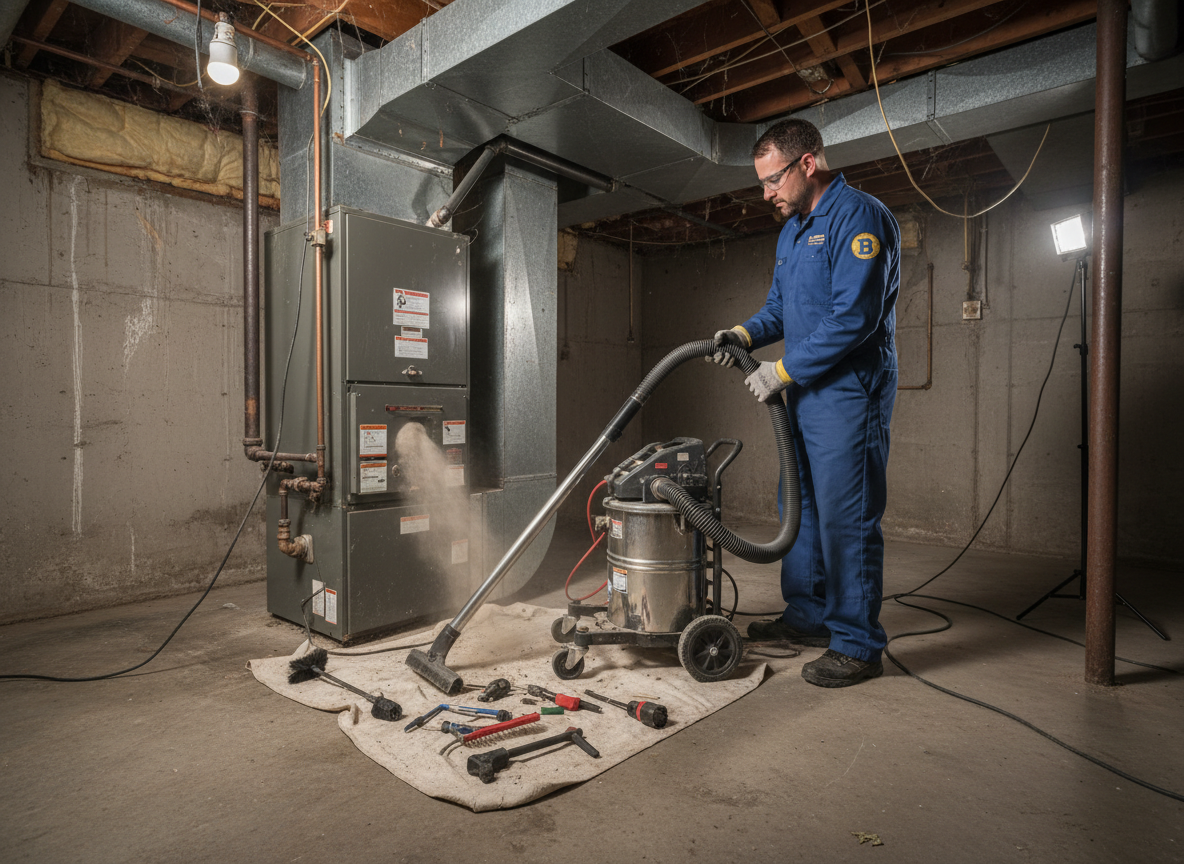
Benbrook homes built from the 1970s through the 1990s often have original sheet-metal ducts routed through crawl spaces or attics. These systems pull in fine red clay particles from the surrounding terrain and construction dust from nearby growth along Highway 377. Furnace and duct cleaning must reach every branch run because restricted airflow forces the furnace to cycle longer during the brief winter cold snaps that drop into the 20s.
Technicians start by mapping the trunk lines and supply registers with a camera to locate sags or disconnected joints common in single-story ranch houses around Benbrook Lake. Negative-pressure equipment is set up at the furnace cabinet so loosened debris travels into the containment unit rather than back into living spaces. Special attention goes to the return-air chase that frequently collects pet dander and insulation fibers in older attics.
After the main trunk and branches are cleaned, the furnace blower housing and heat exchanger are vacuumed to remove the layer that reduces efficiency. Registers are removed and washed on site so reinstallation leaves no residue on floors or carpet. Homeowners in the Benbrook Hills neighborhood often request this step because their homes have wall registers that sit low and collect settled dust year-round.
Final airflow readings are taken at each register to confirm the system moves air at pre-clean levels. Any damaged flex runs discovered during the job are flagged for the homeowner because replacement falls outside the cleaning scope and requires a separate HVAC contractor.
Technician insight
In Benbrook, the thing that catches most people out with furnace and duct cleaning is the fine red clay that infiltrates older ductwork in homes built before 1990 around Benbrook Lake, especially after spring rains leave the soil loose and winds carry it into return-air openings.
Reduced Airflow In A 1982 Benbrook Ranch
A homeowner near Benbrook Lake reported weak airflow from several floor registers during the first cold snap. Camera inspection showed heavy clay dust and insulation fibers packed in the return chase running through the attic. The crew performed full negative-pressure cleaning of the trunk and branches plus the blower assembly. Airflow readings returned to normal and the furnace cycled properly again.
How it works
- 1
System Mapping And Camera Inspection
Technicians trace every supply and return line from the furnace in the utility room or attic, recording length, material, and any visible disconnections common in Benbrook ranch homes.
- 2
Negative-Pressure Setup
A containment unit is attached at the furnace and registers are sealed so dust moves only toward the vacuum, protecting interior spaces during the clean.
- 3
Agitation And Extraction
Rotating brushes and compressed-air whips loosen debris along the full length of each duct while the vacuum pulls material into the collection drum.
- 4
Blower And Register Detail
The furnace blower wheel, heat exchanger, and each floor or wall register receive separate vacuuming and washing before reassembly.
- 5
Post-Clean Airflow Verification
Readings are taken at multiple registers to confirm restored airflow before the system is returned to normal operation.
Pricing
Pricing varies by number of runs, furnace location, and access difficulty in crawl spaces or attics; we provide an upfront quote after the initial inspection.