Benbrook sits in Tarrant County just west of Fort Worth, where many neighborhoods like Benbrook Hills and the original 1950s-1970s subdivisions contain slab-on-grade homes with flex duct runs that trap cottonwood fluff and road dust from nearby I-20. Summer temperatures routinely push AC units into constant operation, circulating the same airborne particles through every register and creating thick layers inside the main trunk lines. Homeowners notice reduced airflow and musty odors especially after the first cool snap in October when systems switch back to heat.
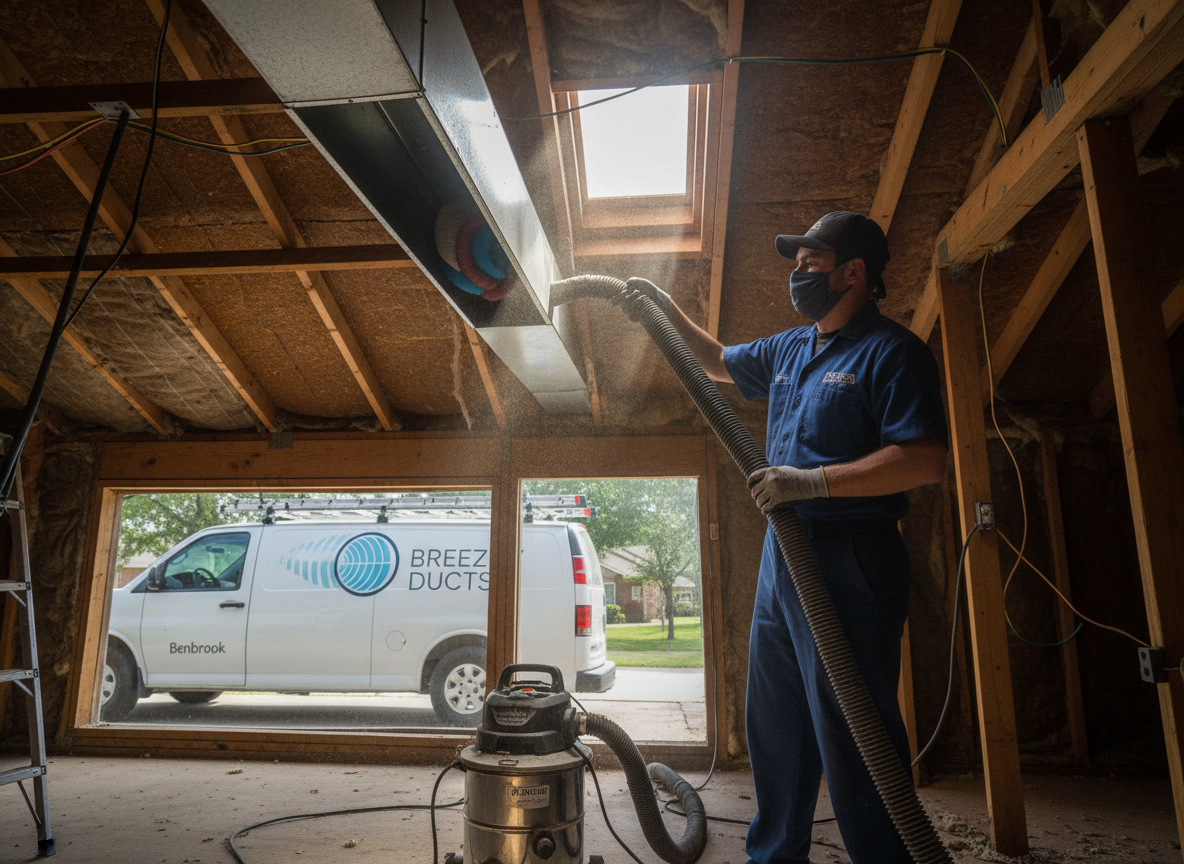
Technicians at Cedar Sync start at the 8516 Benbrook Blvd shop and bring negative-air machines sized for typical 1,800- to 2,400-square-foot Benbrook floor plans. They isolate each branch run rather than relying on a single whole-house vacuum, because older sheet-metal joints in these homes often leak when full suction is applied. Special attention goes to the return-air chase that pulls air from laundry rooms and garages, where pet hair and dryer lint accumulate fastest.
After cleaning, registers are wiped and the system is run for ten minutes so any remaining loose material exits through the filters. This step prevents the common complaint of dust reappearing within days. Because Benbrook sits on clay soils that expand and contract, some duct sections shift slightly each season; crews check for disconnected joints before leaving the job.
Technician insight
In Benbrook the thing that catches most people out with Duct cleaning services near me is the way clay soil movement under 1960s slab homes slowly separates flex duct joints; if you only vacuum from the furnace you leave pockets of dust that re-enter the system the first time the AC kicks on hard after a July heat wave.
Disconnected Flex Run in Benbrook Hills
Homeowner reported weak airflow in two bedrooms after spring pollen season. Inspection found a flex duct joint pulled apart under the slab edge where soil had shifted. Crew reconnected the section, cleaned the remaining runs, and restored full airflow to the affected rooms.
How it works
- 1
Site Assessment
Walk through the home, note register locations, and measure trunk and branch sizes to select proper equipment.
- 2
Isolation and Vacuum
Seal off individual runs and apply negative pressure to pull debris toward the collection unit without disturbing the rest of the system.
- 3
Agitation and Extraction
Use rotating brushes sized for each duct diameter to loosen buildup, then extract material through the vacuum hose.
- 4
Final Run and Inspection
Restart the HVAC for ten minutes, check airflow at each register, and confirm no loose material remains.
Pricing
Cost depends on number of runs, access difficulty, and whether the home has flex or rigid duct; call for a site visit quote.